Width detection: the tolerance of webbing with width of 1 "and above shall not exceed ± 0.25 points; The tolerance of webbing with width of 25MM and above shall not exceed ± 0.5MM; The standard tolerance of webbing width of 1 "and less than 25MM shall not exceed ± 0.25MM; Note: The flat end and herringbone edging webbing must be of sufficient size, but not more than 0.25 points. Thickness inspection: the tolerance shall not exceed ± 0.1MM; Color difference test: there is no yin and yang color on the belt surface by naked eye, and the needle edge and cloth edge cannot be exchanged for the color and texture (the needle edge of each woven belt must be of one color). Singeing and labeling: Each bag ribbon must be singed thoroughly, but cannot be burnt. The quality inspector shall inspect the packaging label to be consistent with the actual goods (specification, color, quantity), and seal it for warehousing. If errors and omissions are found, the relevant processes shall be traced in time, and the relevant personnel shall be held accountable according to the seriousness of the case.
The basic process flow of knitting is: bleaching and dyeing - weft rolling - weaving - off machine cutting - packaging. Since 1960, many technical innovations have been carried out on the knitting machine, mainly including the enlargement of peach plate diameter, the installation of an automatic stop device for breaking rubber bands, and the replacement of iron ingots with nylon ingots. The improvement of these equipment has increased the vehicle speed to 160~190 rpm, doubled the stand rate and greatly improved the product quality. In 1980, SD-81A and B rubber ingot belts were developed, which are soft, light, thin, firm, with small elongation, small impact force, short and flat joints. At the beginning of 1990, the trial production of car seat belts for Santana cars was successful. After more than two years of research and trial production, the product quality reached QC49-92 and TL-VW470 standards.

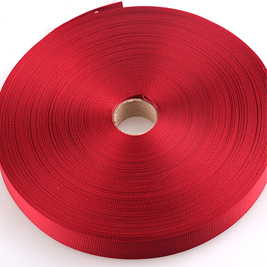
The application of is already very common, and the technology is also new one by one. Let's talk about it briefly from the manufacturer's editor. I hope it can help. It is well known that it has been widely used. Now many bag webbing manufacturers are constantly upgrading their products to make our life more convenient. Knitting can not only weave belts, but also weave ropes. Tubular belt is a kind of braided rope. Rope or rope with a diameter of 1~4 cm is also called rope. Rope with a diameter of more than 4 cm is also called rope. Rope with a diameter of more than 40 cm is generally called cable or rope.

After yarn warp cylinder and weft winding form weft tube, customized Backpack webbing manufactor It is inserted on the fixed gear seat of the knitting machine, and the weft tube rotates and moves along the 8-shaped track to draw the yarns to cross weave with each other. Usually, the number of spindles is even, the woven tape is tubular, the number of spindles is odd, and the woven tape is flat. Spindle weaving technology has been applied since old China. The number of spindles varies from 9 to 100 due to different equipment. The basic process of weaving is: bleaching and dyeing - weft rolling - weaving - off machine shearing - packaging. Since 1960, make well-connected customized Backpack webbing Several technical innovations were carried out on the knitting machine, mainly including the enlargement of peach plate diameter, the installation of an automatic stop device for breaking rubber bands, and the replacement of iron ingots with nylon ingots. The improvement of these equipment has increased the vehicle speed to 160~190 rpm, doubled the stand rate and greatly improved the product quality.